Meet the Cretaceous Sea Monsters: Unveiling the Ancient Giant Octopuses
In a revelation that's left marine biologists and paleontologists shell-shocked, a team of researchers has uncovered evidence of gargantuan octopuses that...
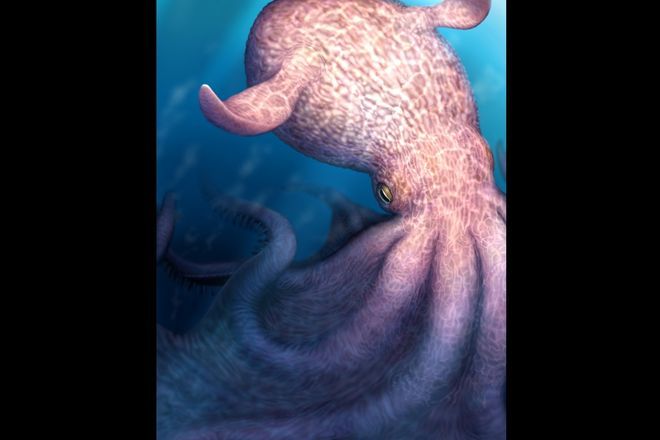
In a revelation that's left marine biologists and paleontologists shell-shocked, a team of researchers has uncovered evidence of gargantuan octopuses that roamed the oceans 80 million years ago. These behemoths, measuring up to 19 meters in length, were likely the undisputed monarchs of the Cretaceous seas.
A Colossal Catch
The study, led by Yasuhiro Iba, an associate professor of paleontology at Hokkaido University, has shed light on a previously unknown chapter in the evolution of cephalopods. According to Iba, the researchers discovered a series of fossilized remains, including a particularly well-preserved specimen, which revealed the astonishing size of these ancient creatures. 'These fossils show us that the octopuses were incredibly large, with some specimens reaching lengths of up to 19 meters,' Iba explained, adding that the sheer scale of these animals would have made them formidable predators.
Imagine an octopus the size of a school bus, with eight arms as long as a tree trunk, capable of crushing the shells of even the largest sea turtles. It's a chilling thought, but one that's rooted in reality.
Unraveling the Mystery of the Giant Octopuses
The research team employed a combination of paleontological and biomechanical techniques to reconstruct the anatomy of these ancient octopuses. By analyzing the fossil evidence and comparing it to modern cephalopod anatomy, they were able to infer the likely behavior and diet of these massive creatures. According to Iba, the giant octopuses were likely apex predators, feeding on a variety of prey, including fish, squid, and even large sea reptiles.
What's Next
The discovery of these gargantuan octopuses has far-reaching implications for our understanding of marine ecosystems during the Cretaceous period. It challenges our current knowledge of the food chain and the role of predators in shaping the evolution of ancient marine life. As researchers continue to unravel the mysteries of these sea monsters, we may uncover more surprises about the complex and fascinating history of our planet's oceans.